Weeks ahead of an
independence referendum for Kurds in Iraq, IRIN finds the would-be nation
divided and cynical
Freelance journalist and regular IRIN
contributor
Author Note
Part of an in-depth IRIN series
exploring the challenges facing Kurdish people throughout the Middle East as
Iraqi Kurds vote on independence
In northern Iraq’s main city of Erbil, the green, white, and red striped
flag of Kurdistan, with its cheerful yellow sun emblem, is everywhere. It hangs
on food stalls, homes, public and government buildings; it even hangs from taxi
rear-view mirrors. But nearly a century after early Kurdish nationalists
introduced the tricolor at the 1919 Paris Peace Conference, it still belongs to
no state.
Kurdish leaders hope to change this on 25 September, when the
semi-autonomous Kurdistan Regional Government (KRG) puts independence to a vote
in a referendum that could create the world’s 194th country (196 if you
include Palestine and the Holy See).
Although a ‘yes’ is the expected outcome of the referendum, with most Iraqi
Kurds in favour of the idea of independence, if not the timing of the vote, it
remains contentious. Iraq, the United States, Iran, and Turkey have all
come out against the referendum, and it is not clear how much popular support
the idea of holding the poll this month has amongst ordinary Kurds.
For years following the fall of Saddam Hussein in 2003, Iraqi Kurdistan
enjoyed a trade, business, and construction boom, but this is now a fading
memory and disillusionment with local politicians has grown. Many may be
ideologically pro-independence, but whether they trust a political
elite accused of cronyism, nepotism, and corruption to carry out a fair
vote or run a state is another matter entirely.
But nationalism is still strong here. There are ties that bind: The
Kurds speak the same languages and have a shared history and culture.
There is also a feeling among some that given the vital role Kurdish fighters
(peshmerga) have played in vanquishing so-called Islamic State,
they’ve earned the right to a nation.
But will nationalism be enough to pull all this off?
Statesman, skyscrapers,
and shepherds
Not so long ago, Erbil’s expansive horizon of modern malls, office
buildings, and designer apartment blocks saw Iraqi Kurdistan proudly dubbed the
new Dubai.
Then came a shock fall in oil prices and deteriorating relations with
Iraq’s central government. The budget went unpaid by Baghdad, leaving the
KRG struggling to pay salaries, while business deals turned sour. Then came IS.
Many international companies fled and construction projects were abandoned.
KRG officials hope to regain this golden decade of Iraqi Kurdistan via
September’s referendum, and in the capital they are adamant independence is the
only way forward. But what appears to be driving this as much as
any growing desire for self-rule is the notion that proceeding as a
unified Iraq is completely untenable.
Sitting behind an enormous desk in Erbil, decorated with Kurdish
memorabilia and awards, his uniform emblazoned with the Kurdish flag,
Brigadier-General Halgwrd Hikmat, head of the peshmerga media ministry, told
IRIN that Iraqi Kurds have given union a fair shot, without much in
return.
“Before 2004, when Saddam was still in power, we had partial independence
and little contact with Iraq. But after Saddam was finished, we decided to try
to build a country [together] because Saddam was a dictator,” he said. “We’ve
been working with the Baghdad government since then and, to be honest, we’ve
got absolutely nothing.”
That nothing is political as well as financial: Hikmat complained that
Kurdish votes in parliament have been ignored, and their proposals overlooked.
“We’ve been together with Iraq for a long time, but it’s reached the point
when we can’t be with them anymore. We can’t work with them anymore,” he said.
“We only want to be neighbours with them now.”
This sense of finality may be relatively new – KRG President Masoud
Barzani, who leads the Kurdish Democratic Party (KDP), only announced the
referendum and its date in June – but the rumblings of discontent have long
been felt among senior figures in Iraqi Kurdistan, even if the three-year
battle against IS obscured some of the underlying differences.
The proverbial straw that broke the camel’s back seems to have been as much
financial as political and top at the list of complaints from Kurdish
officials is the central government’s failure to give Kurdistan its 17 percent
share of the national budget for more than three years.
Budget anomalies have not been helped by Iraqi Kurdistan selling oil sale
independently, particularly through a pipeline to Turkey. Pocketing profits for
the KRG instead of pouring them into the central government coffers only made
Baghdad more intransigent about the budget. “The equation is simple: you take
17 percent of the wealth, you hand over the oil you have,” former Iraqi Prime
Minister Nuri al-Maliki told France-24
in early 2014.
Jutyar Mahmoud, a member of the region’s Independent High Elections and
Referendum Commission, told IRIN that the KRG has had to cut public workers’
salaries by 75 percent and that even the peshmerga – on the front lines of
deadly battles including Mosul –
have received almost no payments for two years.
“Iraq cut the money. They cut medicines being sent to the KRG. They cut
everything and left us unable to pay peshmerga salaries at a time when we were
fighting Daesh,” he said, using the Arabic acronym for IS.
“We tried everything to work with Baghdad and we didn’t get anything,”
Mahmoud said. “Independence is a last resort, but Kurdish people believe that
an independent state is the only guarantee for us, not just for financial
stability but also our safety and security.”
Times may be relatively tough in Erbil, but it is elsewhere that
the financial hardship and insecurity are felt most keenly.
Some three million people across the whole of Iraq have been displaced by
the fight against IS, and far from the modernity of Erbil, rural poverty
is the reality for many.
On the road to Zakho, a main border crossing with Turkey, lorries hurtle
dangerously fast down a battered road, while shepherds herd sheep home at dusk
along its dusty edges. In Iraqi Kurdistan, modernity and tradition run, often
uncomfortably, side by side. Opinions, too, are divided.
Preparing pickles in a roadside shop just outside Dohuk, teacher Mohamed
enthused that the referendum was exactly what the people in Iraqi Kurdistan
wanted, needed, and deserved.
But, at the opposite end of the country, outside the town of Choman, two
young famers making evening tea on a makeshift fire beside the
road had a different take.
“We will be voting ‘no’ to the referendum. There is not the suitable basis
for conducting a referendum now,” said 22-year-old Safir, pointing out that the
KRG’s parliament hadn’t met in two years due to
internal disputes.
Safir also anticipated, in worried tones, that any salaries still paid by
the central government in Baghdad would be cut completely if independence was
declared. From his roadside perspective, the vote could make things much
worse.
Blame Sykes-Picot?
Beyond the recent
financial complaints – and they are real – Kurdish people’s distrust of a
unified Iraq has deeper roots.
In his office near the Hawija front
line against IS, softly-spoken peshmerga commander Kemal Kerkuki told IRIN
late last year that his forces were purely fighting to protect Kurdish
territories.
“We are working for an
independent Kurdistan not for Iraqi unity,” Kerkuri said, flanked by a
large Kurdish flag and an IS drone shot down by his forces a few days
earlier. “If I thought for a moment I was working for a unified Iraq, I
would not stay here for one second.”
“We don’t trust the
Iraqis,” he continued. “In the last 30 years we have faced five genocides,
including with chemical weapons. It is actually shameful for us to stay in this
country.”
There’s no question the
Kurds have suffered at the hands of the central Iraqi government, most
infamously when Saddam’s forces released mustard gas and
nerve agents on the town of Halabja in 1988, killing an
estimated 5,000 people.
This was not an isolated
attack, but rather part of a longer campaign, known as Anfal (chemical), during
the end of the 1980-1988 Iran-Iraq war, when Iraqi forces slaughtered tens of
thousands of people in an attempt to quell the restive Kurds.
But Kerkuki went even
further back, to 1916, when Britain and France carved up the Middle East: “When
they drew a map for this region with the Sykes-Picot Agreement, they ignored
the Kurdish people and Kurdistan,” he said. “So, for 100 years we have been in
difficulties.”
For Kerkuki, the
differences that make unity with Iraq unviable run deep.
“Everything about the
Kurds and the Iraqis is different – our history, our tradition, our culture,
our people, our lifestyles, our faces, our genetics – everything,” he said. “We
can be good neighbours and friends, but not brothers. When anyone claims we are
brothers, it is a big lie.”
Disputed territories,
ineligible voters
Central to concerns about
the Kurdish referendum are the so-called disputed territories of northern
Iraq, including parts (or all) of the provinces of Nineveh, Kirkuk and
Diyala. Historical ownership is disputed and the populations ethnically mixed.
Under Saddam’s rule, many of these areas were settled by Arabs as part of his
wider Arabisation policies.
For the most part, the
different ethnicities have lived side by side, peacefully for decades. But
since the recent offensives against IS, rights groups have documented post-liberation
retribution by Kurdish fighters against predominantly Sunni Arabs they see as
having supported the extremists, although the peshmerga’s Kerkuki was
adamant that many of these reports are inaccurate.
The contested territories
were outlined in the Iraqi constitution, ratified in 2005. At the time, a
provision – Article 140 – was made that should have enabled residents to choose
whether they wanted to remain under the control of Baghdad or the KRG. 2007 was
set as a cut-off date for that referendum, but it never happened. Kurdish
officials claim the central government has deliberately dragged its heels,
repeatedly postponing the issue.
Officials say any segments
of these disputed territories currently under Kurdish control will be allowed
to vote in the referendum, but this doesn’t mean everyone will have a
say. The electoral commission’s Mahmoud explained that in the hotly contested
oil-rich province of Kirkuk, for example, only Arabs originally from the area
will be eligible to vote, excluding anyone who has moved there since the start
of Saddam’s regime in the 1970s.
Eligible voters displaced
from their homes in the KRG or disputed territories will be able to vote via
ballot boxes in camps. But Kurds living in parts of the disputed territories
not currently under Kurdish control will not be able to vote at
all. That’s simply a question of access, said Mahmoud: “Our borders are where
the peshmerga are; so areas beyond that, including some IDP camps, will be
impossible for us to access.”
Potential Kurdish voters
in such areas are understandably upset at being disenfranchised.
Fear and discontent
At one border post between
the KRG and Iraq, near Makhmour, battle-weary peshmerga expressed concerns that
the vote could bring more conflict – something they’ve seen more than enough of
in recent years.
“Maybe the new Kurdish
state is going to be dangerous,” said one young soldier. “Maybe we’ll have a
war with Iraq, and that’s not what we want. We don’t like war.”
The
commission’s Mahmoud conceded that if independence is declared, a war
based around border disputes was a real danger.
The official peshmerga
position – one that resonates with many at home and abroad – is that Iraqi
Kurds have effectively won the right of independence through their fight
alongside Iraqi forces and other allies against IS. It’s clearly what Hikmat,
at the peshmerga media ministry in Erbil, believes. “A lot of people have died
for this cause,” he told IRIN. “We have had a lot of martyrs over the years; so
of course the peshmerga answer is, ‘we have to get independence’, because that
is what we have been fighting for.”
But one former peshmerga,
a woman in her sixties, told IRIN she had made massive personal sacrifices for
the Kurdish cause but been left poverty-stricken. “If they really wanted the
public’s opinion, they could ask us. But they don’t care about our opinion.
They’re telling us what to say,” she said.
Hitch-hiking near
Sulaymaniyah and carrying a bag of onions she had walked 40 kilometres to
collect, she added cynically: “Whatever the outcome of the referendum, the
benefits will not be for the people, they will be for the politicians.”
On the outskirts of Kirkuk,
two farmers selling fresh fruit and vegetables from a roadside stall were
worried about the possible economic tensions ahead.
“The bulk of our fruit and
vegetables go to Baghdad and we are terrified that, if they announce
independence here, Iraq will close the borders and block the roads, and our
future will be ruined,” said 47-year-old Hajarr. “If there was an agreement
between the KRG and Baghdad about the referendum, it might be okay, but so far
there is no such agreement in place.”
Other businessmen told
IRIN that Baghdad is so reliant on the KRG and Turkish imports – Iran is a
major source too – that imposing border restrictions would be out of the
question.
“The central government in
Baghdad is paying our famers for essentials like wheat and barley as well as
some poultry and other foodstuffs,” said agricultural engineer Ibrahim Muayad
Dawood, who works with a Russian trading company headquartered in Erbil. “Also,
every product from Turkey or coming from other countries has to come through
KRG’s land border. We are a land bridge between Turkey and Iraq.”
Logistical nightmare
The leading proponents of
the referendum promise that independence will bring increased stability and
economic gains. However, pulling the poll off will not only mean
overcoming internal scepticism but also performing a major administrative coup.
Six million Iraqi Kurds
and long-term residents of Iraqi Kurdistan are expected to register,
according to Mahmoud at the electoral commission. But an Iraqi ration
card, along with Kurdish identification, is required to prove eligibility, and
this has reportedly proved contentious as many in the diaspora no longer have
these cards to hand.
In addition to the
question of how voting in disputed territories will work, several other
anomalies were still being ironed out weeks before the vote. Iraqi Kurds
living abroad will apparently be able to vote electronically. Returnees who
were born abroad – many came back during the oil boom – will also be able to
vote if they have the necessary documents. But Kurds living in Iraq will
not be eligible to vote unless their ID documents are registered in the KRG, a
regulation IRIN did not find to be widely understood.
Of greater concern, while
the majority of Kurds IRIN spoke to were at least aware that a vote was on the
horizon, this was not uniformly true. Word did not appear to have reached
the region’s northeastern border areas, where farmers move their families to
fertile mountainous pastures every summer when the snows melt.
“Referendum? What is it?”
asked one shepherd, perplexed. When it was explained to him, he shook his head
and said: “I don’t understand what this is. I don’t know anything about it,”
ushering his flock of several hundred sheep towards a valley.
Six weeks prior to
the referendum, little effort appeared to have been made by the Kurdish
authorities to reach these remote rural communities to explain the forthcoming
vote. Mahmoud’s pledges of an upcoming education campaign would seem to be
a case of too little too late.
Wider Kurdistan?
What’s largely being ignored is that the bid for an independent Iraqi
Kurdistan is really a watered-down version of the overarching Kurdish state
once envisioned as including Kurds from Iran, Turkey, and Syria.
Turkey’s opposition to the referendum is born out of its reluctance to
encourage Kurdish nationalism within its own borders. A nearly 40-year conflict
with the separatist Kurdistan Workers’ Party (PKK) has left countless civilians
dead -- the UN counted 2,000 killed
in 18 months after a truce broke down in 2015.
In Syria, the Democratic Union Party (PYD) runs the self-declared
Democratic Federation of North Syria, with a presence from the opposition
Kurdish National Council (ENKS).
Separatist movements in these countries have split (and split again), and
to some extent the Iraqi Kurds are going it alone – with the help of exiled
Iranian Kurds who have sought refuge in the KRG for decades, many of whom are
part of the Democratic Party of Iranian Kurdistan (KDPI) or an associated
branch of the peshmerga.
KDPI commander Aziz Seleghi isn’t eligible to vote but he is
unequivocal in his support of the referendum, seeing it as part of the larger
struggle for Kurdish nationalism.
“We support the referendum and we are ready to take any risk to defend the
referendum if Iraq or Iran attacks us,” he said. “It was the same with IS three
years ago. When they came, we went straight to the borders to protect Iraqi
Kurdistan.”
Seleghi said the vote would send a clear message to the world that Kurdish
people want independence and are determined to get it.
But another KDPI commander told IRIN that the KRG was widely viewed across
the larger Kurdish region as betraying the Kurdish cause, particularly for
brokering deals with Iran and Turkey, two countries accused of persecuting
their minority Kurdish populations.
“We don’t like this capitalism in the KRG,” said a young KDPI soldier.
“Many Kurds support this referendum, but the truth is that... [some senior
political figures have] basically sold out Kurdistan. Independence like
this is not what we wanted – it’s not what we have been have been fighting for
and it is not good for all the Kurds.”
At a makeshift dining table in the orchard, where KDPI soldiers hung their
weapons on olive trees while they ate meals, another soldier wrote out a poem
in Persian on the plastic tablecloth. It read:
I live as a Kurd,
I die as a Kurd.
When they come for me,
I will answer in the Kurdish tongue.
In the next life, I will live as a Kurd,
And there I will make another revolution.
Whatever the outcome of the referendum in Iraqi Kurdistan in two short
weeks’ time, the wider Kurdish struggle will be far from over.
www.irinnews.org
Sykes-Picot Agreement 1916
WRITTEN BY:
Alternative Title: Asia Minor Agreement
Sykes-Picot Agreement, also called Asia
Minor Agreement, (May 1916), secret convention made during World War I between Great Britain and France, with the assent
of imperial Russia, for the
dismemberment of the Ottoman Empire. The
agreement led to the division of Turkish-held Syria, Iraq, Lebanon, and Palestine into
various French- and British-administered areas. Negotiations were begun in
November 1915, and the final agreement took its name from its negotiators, Sir Mark Sykes of Britain and
François Georges-Picot of France.
Its provisions were as
follows: (1) Russia should acquire the Armenian provinces of Erzurum, Trebizond (Trabzon), Van, and Bitlis, with some
Kurdish territory to the southeast; (2) France should acquire Lebanon and the
Syrian littoral, Adana, Cilicia, and the
hinterland adjacent to Russia’s share, that hinterland including
Aintab, Urfa, Mardin, Diyarbakır, and Mosul; (3) Great Britain
should acquire southern Mesopotamia, including Baghdad, and also the
Mediterranean ports of Haifa and ʿAkko (Acre); (4)
between the French and the British acquisitions there should be a confederation
of Arab states or a single independent Arab state, divided into French and
British spheres of influence; (5) Alexandretta (İskenderun) should be a
free port; and (6) Palestine, because of the holy places, should be under an
international regime.
This secret arrangement
conflicted in the first place with pledges already given by the British to the
Hāshimite dynast Ḥusayn ibn ʿAlī, sharif
of Mecca, who was about to
bring the Arabs of the Hejaz into revolt
against the Turks on the understanding that the Arabs would eventually receive
a much more important share of the fruits of victory. It also excited the
ambitions of Italy, to whom it was
communicated in August 1916, after the Italian declaration of war against
Germany, with the result that it had to be supplemented, in April 1917, by the Agreement of
Saint-Jean-de-Maurienne, whereby Great Britain and France promised
southern and southwestern Anatolia to Italy.
The defection of Russia from the war canceled the Russian aspect of the
Sykes-Picot Agreement, and the Turkish Nationalists’ victories after the
military collapse of the Ottoman Empire led to the gradual abandonment of its
projects for Anatolia. The Arabs, however, who had
learned of the Sykes-Picot Agreement through the publication of it, together
with other secret treaties of imperial Russia, by the Soviet Russian government
late in 1917, were scandalized by it, and their resentment persisted despite
the modification of its arrangements for the Arab countries by the Allies’ Conference of San Remo in
April 1920.
www.britannica.com
World War I
1916
Britain and France
conclude Sykes-Picot agreement
On May 19, 1916,
representatives of Great Britain and France secretly reach an accord, known as
the Sykes-Picot agreement, by which most of the Arab lands under the rule of
the Ottoman Empire are to be divided into British and French spheres of
influence with the conclusion of World War I.
After the war broke out in
the summer of 1914, the Allies—Britain, France and Russia—held many discussions
regarding the future of the Ottoman Empire, now fighting on the side of Germany
and the Central Powers, and its vast expanse of territory in the Middle East,
Arabia and southern-central Europe. In March 1915, Britain signed a secret
agreement with Russia, whose designs on the empire’s territory had led the
Turks to join forces with Germany and Austria-Hungary in 1914. By its terms,
Russia would annex the Ottoman capital of Constantinople and retain control of
the Dardanelles (the crucially important strait connecting the Black Sea with
the Mediterranean) and the Gallipoli peninsula, the target of a major Allied
military invasion begun in April 1915. In return, Russia would agree to British
claims on other areas of the former Ottoman Empire and central Persia,
including the oil-rich region of Mesopotamia.
More than a year after the
agreement with Russia, British and French representatives, Sir Mark Sykes and
Francois Georges Picot, authored another secret agreement regarding the future
spoils of the Great War. Picot represented a small group determined to secure
control of Syria for France; for his part, Sykes raised British demands to
balance out influence in the region. The agreement largely neglected to allow
for the future growth of Arab nationalism, which at that same moment the
British government and military were working to use to their advantage against
the Turks.
In the Sykes-Picot
agreement, concluded on May 19, 1916, France and Britain divided up the Arab
territories of the former Ottoman Empire into spheres of influence. In its
designated sphere, it was agreed, each country shall be allowed to establish
such direct or indirect administration or control as they desire and as they
may think fit to arrange with the Arab State or Confederation of Arab States.
Under Sykes-Picot, the Syrian coast and much of modern-day Lebanon went to
France; Britain would take direct control over central and southern
Mesopotamia, around the Baghdad and Basra provinces. Palestine would have an
international administration, as other Christian powers, namely Russia, held an
interest in this region. The rest of the territory in question—a huge area
including modern-day Syria, Mosul in northern Iraq, and Jordan—would have local
Arab chiefs under French supervision in the north and British in the south.
Also, Britain and France would retain free passage and trade in the other’s
zone of influence.
http://www.history.com
Pre-State Israel: The
Sykes-Picot Agreement
(1916)
The Sykes-Picot Agreement
(officially the 1916 Asia Minor Agreement) was a secret agreement reached
during World War I between the British and French governments
pertaining to the partition of the Ottoman Empire among the Allied Powers.
Russia was also privy to the discussions.
|
The Middle East per the Sykes-Picot Agreement. |
The first round of
discussions took place in London on November 23, 1915 with the French
government represented by François-Georges Picot, a professional diplomat with
extensive experience in the Levant, and the British delegation led by Sir
Arthur Nicolson. The second round of discussions took place December 21 with
the British now represented by Sir Mark Sykes, a leading expert on the
East.
Having juxtaposed the
desiderata of all the parties concerned - namely the British, the French and
the Arabs - the two statesmen worked out a compromise solution. The terms of
the partition agreement were specified in a letter dated May 9, 1916, which
Paul Cambon, French ambassador in London, addressed to Sir Edward Grey, British
foreign secretary. These terms were ratified in a return letter from Grey to
Cambon on May 16 and the agreement became official in an exchange of notes
among the three Allied Powers on April 26 and May 23, 1916.
According to the
agreement, France was to exercise direct control over Cilicia, the coastal
strip of Syria, Lebanon and the greater part of Galilee, up to the line
stretching from north of Acre to the northwest corner of the Sea of Galilee ("Blue
Zone"). Eastward, in the Syrian hinterland, an Arab state was to be
created under French protection ("Area A"). Britain was
to exercise control over southern Mesopotamia ("Red Zone"), as
well as the territory around the Acre-Haifa bay in the Mediterranean with
rights to build a railway from there to Baghdad. The territory east of the
Jordan River and the Negev desert, south of the line stretching from Gaza to
the Dead Sea, was allocated to an Arab state under British protection ("Area B").
South of France's "blue zone," in the area covering the Sanjak of
Jerusalem and extending southwards toward the line running approximately from
Gaza to the Dead Sea, was to be under international administration ("Brown
Zone").
In the years that
followed, the Sykes-Picot Agreement became the target of bitter criticism both
in France and in England. Lloyd George referred to it as an
"egregious" and a "foolish" document. Zionist aspirations
were also passed over and this lapse was severely criticized by William R.
Hall, head of the Intelligence Department of the British Admiralty, who pointed
out that the Jews have "a strong material, and a very strong political
interest in the future of the country and that in the Brown area the question
of Zionism… [ought] to be considered."
|
Areas of Palestine per the agreement |
The agreement was
officially abrogated by the Allies at the San Remo Conference in April 1920,
when the Mandate for Palestine was conferred upon Britain.
Text of Sykes-Picot
Agreement
It is accordingly understood between the French and
British governments:
That France and Great Britain are prepared to recognize
and protect an independent Arab states or a confederation of Arab states (a)
and (b) marked on the annexed map, under the suzerainty of an Arab chief. That
in area (a) France, and in area (b) great Britain, shall have priority of right
of enterprise and local loans. That in area (a) France, and in area (b) great
Britain, shall alone supply advisers or foreign functionaries at the request of
the Arab state or confederation of Arab states.
That in the blue area France, and in the red area great
Britain, shall be allowed to establish such direct or indirect administration
or control as they desire and as they may think fit to arrange with the Arab
state or confederation of Arab states.
That in the brown area there shall be established an
international administration, the form of which is to be decided upon after
consultation with Russia, and subsequently in consultation with the other
allies, and the representatives of the Shariff of .
That great Britain be accorded (1) the ports of Haifa and
acre, (2) guarantee of a given supply of water from the Tigres and Euphrates in
area (a) for area (b). His majesty's government, on their part, undertake that
they will at no time enter into negotiations for the cession of Cyprus to any
third power without the previous consent of the French government.
That Alexandretta shall be a free port as regards the
trade of the British empire, and that there shall be no discrimination in port
charges or facilities as regards British shipping and British goods; that there
shall be freedom of transit for British goods through Alexandretta and by
railway through the blue area, or (b) area, or area (a); and there shall be no
discrimination, direct or indirect, against British goods on any railway or
against British goods or ships at any port serving the areas mentioned.
That Haifa shall be a free port as regards the trade of
France, her dominions and protectorates, and there shall be no discrimination
in port charges or facilities as regards French shipping and French goods.
There shall be freedom of transit for French goods through Haifa and by the
British railway through the brown area, whether those goods are intended for or
originate in the blue area, area (a), or area (b), and there shall be no
discrimination, direct or indirect, against french goods on any railway, or
against french goods or ships at any port serving the areas mentioned.
That in area (a) the Baghdad railway shall not be
extended southwards beyond Mosul, and in area (b) northwards beyond Samarra,
until a railway connecting Baghdad and Aleppo via the Euphrates valley has been
completed, and then only with the concurrence of the two governments.
That great Britain has the right to build, administer,
and be sole owner of a railway connecting Haifa with area (b), and shall have a
perpetual right to transport troops along such a line at all times. It is to be
understood by both governments that this railway is to facilitate the
connection of Baghdad with Haifa by rail, and it is further understood that, if
the engineering difficulties and expense entailed by keeping this connecting line
in the brown area only make the project unfeasible, that the french government
shall be prepared to consider that the line in question may also traverse the
Polgon Banias Keis Marib Salkhad tell Otsda Mesmie before reaching area (b).
For a period of twenty years the existing Turkish customs
tariff shall remain in force throughout the whole of the blue and red areas, as
well as in areas (a) and (b), and no increase in the rates of duty or
conversions from ad valorem to specific rates shall be made except by agreement
between the two powers.
There shall be no interior customs barriers between any
of the above mentioned areas. The customs duties leviable on goods destined for
the interior shall be collected at the port of entry and handed over to the
administration of the area of destination.
It shall be agreed that the french government will at no
time enter into any negotiations for the cession of their rights and will not
cede such rights in the blue area to any third power, except the Arab state or
confederation of Arab states, without the previous agreement of his majesty's
government, who, on their part, will give a similar undertaking to the french
government regarding the red area.
The British and French government, as the protectors of
the Arab state, shall agree that they will not themselves acquire and will not
consent to a third power acquiring territorial possessions in the Arabian
peninsula, nor consent to a third power installing a naval base either on the
east coast, or on the islands, of the red sea. This, however, shall not prevent
such adjustment of the Aden frontier as may be necessary in consequence of
recent Turkish aggression.
The negotiations with the Arabs as to the boundaries of
the Arab states shall be continued through the same channel as heretofore on
behalf of the two powers.
It is agreed that measures to control the importation of
arms into the Arab territories will be considered by the two governments.
I have further the honor to state that, in order to make
the agreement complete, his majesty's government are proposing to the Russian
government to exchange notes analogous to those exchanged by the latter and
your excellency's government on the 26th April last. Copies of these notes will
be communicated to your excellency as soon as exchanged. I would also venture
to remind your excellency that the conclusion of the present agreement raises,
for practical consideration, the question of claims of Italy to a share in any
partition or rearrangement of turkey in Asia, as formulated in Article 9 of the
agreement of the 26th April, 1915, between Italy and the allies.
His Majesty's Government further consider that the
Japanese government should be informed of the arrangements now concluded.
Sources:. © 2008 The Gale Group. All Rights Reserved.
and [the maps are not in the original document]
L. Stein, The Balfour Declaration (1961), 237–69, index; E. Kedourie, England and the Middle East (1956), 29–66, 102–41; J. Nevakivi, Britain, France and the Arab Middle East (1969), 35–44, index; C. Sykes, Two Studies in Virtue (1953), index; H.F. Frischwasser-Ra'ana, The Frontiers of a Nation (1955), 5–73; I. Friedman, The Question of Palestine, 1914 – 1918. British-Jewish-Arab Relations (1973, 19922), 97–118; idem, Palestine: A Twice Promised Land? The British, the Arabs and Zionism, 1915 – 1920 (2000), 47–60.
and [the maps are not in the original document]
L. Stein, The Balfour Declaration (1961), 237–69, index; E. Kedourie, England and the Middle East (1956), 29–66, 102–41; J. Nevakivi, Britain, France and the Arab Middle East (1969), 35–44, index; C. Sykes, Two Studies in Virtue (1953), index; H.F. Frischwasser-Ra'ana, The Frontiers of a Nation (1955), 5–73; I. Friedman, The Question of Palestine, 1914 – 1918. British-Jewish-Arab Relations (1973, 19922), 97–118; idem, Palestine: A Twice Promised Land? The British, the Arabs and Zionism, 1915 – 1920 (2000), 47–60.
Sykes–Picot Agreement
From Wikipedia, the free
encyclopedia
The Sykes–Picot Agreement /ˈsaɪks pi.koʊ/, officially known as
the Asia Minor Agreement, was a secret 1916 agreement between the United
Kingdom and France,[1] to which the Russian Empire assented. The agreement
defined their mutually agreed spheres of
influence and control in Southwestern Asia. The agreement was based on
the premise that the Triple
Entente would succeed in defeating the Ottoman Empire during World War I. The negotiations leading to the
agreement occurred between November 1915 and March 1916 [2] and it was signed 16 May 1916.[3] The deal, exposed to the public in Izvestia and Pravda on
23 November 1917 and in the British Guardian on November 26, 1917,[4][5] is still mentioned when considering
the region and its present-day conflicts.[6][7]
The agreement allocated to Britain control of areas
roughly comprising the coastal strip between the Mediterranean Sea and the River Jordan, Jordan,
southern Iraq, and an additional small area that
included the ports of Haifa and Acre, to allow access to the Mediterranean.[8] France got control of southeastern Turkey,
northern Iraq, Syria and Lebanon.[8] Russia was to get Istanbul,
the Turkish
Straits and Armenia.[8] The controlling powers were left free
to determine state boundaries within their areas.[8] Further negotiation was expected to
determine international administration in the "brown area" (an area
including Jerusalem,
similar to and slightly smaller than Mandate Palestine), the form of which was
to be decided upon after consultation with Russia, and subsequently in
consultation with the other Allies, and the representatives of Hussein bin
Ali, Sharif of Mecca.[8]
The agreement effectively divided the Ottoman Arab
provinces outside the Arabian peninsula into areas of British
and French control and influence,[9] and led later to the subsequent partitioning
of the Ottoman Empire following Ottoman defeat in 1918. The Acre-Haifazone
was intended to be a British enclave in
the North to enable access to the Mediterranean.[10] The British later gained control of
the brown zone and other territory in 1920 and ruled it as Mandatory
Palestine from 1923 until 1948. They also ruled Mandatory Iraq from 1920 until 1932, while
the French
Mandate for Syria and the Lebanon lasted from 1923 to 1946. The
terms were negotiated by British diplomat Mark Sykes and a French counterpart, François
Georges-Picot. The Tsarist government was a minor party to the
Sykes–Picot agreement, and when, following the Russian
Revolution, the Bolsheviks published the agreement on 23
November 1917, "the British were embarrassed, the Arabs dismayed and the
Turks delighted."[11]
The agreement is seen by many as a turning point in Western and Arab relations. It negated the UK's
promises to Arabs[12] made for a national Arab homeland in
the area of Greater
Syria, in exchange for supporting the British against the Ottoman
Empire.
Motivation
and Negotiations
In the Constantinople
Agreement earlier in 1915, following the start of naval
operations in the run up to the Gallipoli
Campaign the Russian Foreign Minister, Sergey Sazonov, wrote to the French and UK
ambassadors and staked a claim to Constantinople and the Straits of Dardanelles. In a series of diplomatic
exchanges over five weeks, the UK and France both agreed, while putting forward
their own claims, to an increased sphere of influence in Iran in the case of
the UK and to an annex of Syria (including Palestine) and Cilicia for
France. The UK and French claims were both agreed all sides also agreeing that
the exact governance of the Holy Places was to be left for later settlement.[13]Although this agreement was ultimately
never implemented because of the Russian revolution, it was in force as well as
a direct motivation for it at the time the Sykes–Picot Agreement was being
negotiated.
The report of the De Bunsen
Committee, prepared to determine British wartime policy toward the
Ottoman Empire, and submitted in June 1915 [14] concluded that, in case of the
partition or zones of influence options then there should be a British sphere
of influence that included Palestine while accepting that there were relevant
French and Russian, as well as Islamic interests in Jerusalem and the Holy
Places.[15][16]
On 21 October 1915, Grey met Cambon and suggested France
appoint a representative to discuss the future borders of Syria as Britain
wished to back the creation of an independent Arab state. At this point Grey
was faced with competing claims from the French and from Hussein and the day
before had sent a telegram to Cairo telling the High Commissioner to be as
vague as possible in his next letter to the Sharif when discussing the
northwestern, Syrian, corner of the territory Husein claimed and left McMahon
with “discretion in the matter as it is urgent and there is not time to discuss
an exact formula,” adding, “If something more precise than this is required you
can give it.” [17]
Mark Sykes had been dispatched on instructions of the War
Office at the beginning of June to discuss the Committee's findings with the
British authorities in the Near and Middle East and at the same time to study
the situation on the spot. He went to Athens, Gallipoli, Sofia, Cairo, Aden,
Cairo a second time and then to India coming back to Basra in September and a
third time to Cairo in November (where he was appraised of the McMahon–Hussein Correspondence)
before returning home on 8 December and finally delivering his report to the
War Committee on 16 December.
The first meeting of the British interdepartmental
committee headed by Sir Arthur Nicolson with François Georges-Picot had already
taken place on 23 November 1915. Picot informed the Nicolson committee that
France claimed the possession of land starting from where the Taurus Mts
approach the sea in Cilicia, following the Taurus Mountains and the mountains
further East, so as to include Diabekr, Mosul and Kerbela, and then returning
to Deir Zor on the Euphrates and from there southwards along the desert border,
finishing eventually at the Egyptian frontier. Picot, however, added that he
was prepared ‘to propose to the French government to throw Mosul into the Arab
pool, if we did so in the case of Bagdad’.
A second meeting of the Nicolson committee with Picot
took place on 21 December 1915 wherein Picot said that he had obtained
permission to agree to the towns of Aleppo, Hama, Homs and Damscus being
included in the Arab dominions to be administered by the Arabs. Although the
French had scaled back their demands to some extent, the British also claimed
to want to include Lebanon in the future Arab State and this meeting also ended
at an impasse.
On 28 December, Mark Sykes informed Clayton that he had
"been given the Picot negotiations". On 3 January 1916, an initialled
memorandum was forwarded to the Foreign Office and after having been circulated
for comments,[a]an interdepartmental conference was convened
by Nicolson on 21 January. On 16 January, Sykes told the Foreign office that he
had spoken to Picot and that he thought Paris would be able to agree.Following
the meeting, a final draft agreement was circulated to the cabinet on 2
February, the War Committee considered it on the 3rd and finally at a meeting
on the 4th between Bonar law, Mr Chamberlain Lord kitchener and others where it
was decided that:
"M.Picot may inform his government that the
acceptance of the whole project would entail the abdication of considerable
British interests, but provided that the cooperation of the Arabs is secured,
and that the Arabs fulfil the conditions and obtain the towns of Homs, hama,
Damascus and Aleppo, the british government would not object to the
arrangement. But, as the Blue Area extends so far Eastwards, and affects
Russian interests, it would be absolutely essential that, before anything was
concluded, the consent of Russia was obtained."
Picot was informed and 5 days later, Cambon told Nicolson
that “the French government were in accord with the proposals concerning the
Arab question”[19]:100–102
Later, in February and March, Sykes and Picot, acted as
advisors to Sir George Buchanan and the French ambassador respectively, during
negotiations with Sazonov. Eventually, Russia having agreed (for a price, as it
obtained large portions of Ottoman territory in the bargain, including
Constantinople and the Straits) on 26 April 1916, the final terms were sent by
Paul Cambon, the French Ambassador in London, to the Secretary of State for
Foreign Affairs, Edward Grey, on 9 May 1916, and ratified in Grey’s reply on 16
May 1916.[20][21]
The
Agreement in Practice[edit]
Syria,
Palestine and the Arabs[edit]
Asquith
Government (1916)[edit]
While Sykes and Picot were in negotiations, discussions
were proceeding in parallel between Cairo and Hussein; Hussein’s reply of 1
January to McMahon’s 14 December of 1915 was received at the Foreign Office,
McMahon’s cover stating:
Satisfactory as it may be to note his general acceptance
for the time being of the proposed relations of France with Arabia, his
reference to the future of those relations adumbrates a source of trouble which
it will be wise not to ignore.I have on more than one occasion brought to the
notice of His Majesty’s Government the deep antipathy with which the Arabs
regard the prospect of French Administration of any portion of Arab territory.
In this lies considerable danger to our future relations with France, because
difficult and even impossible though it may be to convince France of her
mistake, if we do not endeavour to do so by warning her of the real state of
Arab feeling, we may hereafter be accused of instigating or encouraging the
opposition to the French, which the Arabs now threaten and will assuredly give.
After discussions, Grey instructed that the French be
informed of the situation although Cambon did not take the matter that
seriously.[19]:103–104
Hussein's letter of 18 February 1916 appealed to McMahon
for £50,000 in gold plus weapons, ammunition and food claiming that Feisal was
awaiting the arrival of ‘not less than 100,000 people’ for the planned revolt
and McMahon's reply of 10 March 1916 confirmed the British agreement to the
requests and concluded the ten letters of the correspondence.
In April and May, there were discussions initiated by
Sykes as to the merits of a meeting to include Picot and the Arabs to mesh the
desiderata of both sides. At the same time, logistics in relation to the
promised revolt were being dealt with and there was a rising level of
impatience for action to be taken by Hussein. Finally, at the end of April,
McMahon was advised of the terms of Sykes-Picot and he and Grey agreed that
these would not be disclosed to the Arabs.[19]:108–112[22]:57–60
Then the Arab revolt was officially initiated by Hussein
at Mecca on 10 June 1916 although his sons ‘Ali and Faisal had already
initiated operations at Medina starting on 5 June.[23]The timing had been brought forward by
Hussein and, according to Cairo [24] "...Neither he nor we were at
all ready in early June, 1916, and it was only with the greatest of difficulty
that a minimum of sufficient assistance in material could be scraped together
to ensure initial success."
Colonel Edouard Brémond was dispatched to Arabia in September
1916 as head of the French military mission to the Arabs. According to Cairo,
Bremond was intent on containing the revolt so that the Arabs might not in any
way threaten French interests in Syria. These concerns were not taken up in
London, British-French cooperation was thought paramount and Cairo made aware
of that.(Wingate was informed in late November that "it would seem
desirable to impress upon your subordinates the need for the most loyal
cooperation with the French whom His Majesty’s Government do not suspect of
ulterior designs in the Hijaz.")[19]:234–5
As 1916 drew to a close, the Asquith governement which
had been under increasing pressure and criticism mainly due to its conduct of
the war, gave way on 6 December to that of David Lloyd George who had been
critical of the war effort and had succeeded Kitchener as Secretary of State
for War after his untimely death in June.Lloyd George had wanted to make the
destruction of Ottoman
Empire a major British war aim, and two days after taking
office told Robertson that he wanted a major victory, preferably the capture of Jerusalem, to impress British public opinion.[25]:119–120 The EEF were, at the time, in
defensive mode at a line on the Eastern edge of the Sinai at El Arish and 15
miles from the borders of Ottoman Palestine. Lloyd George “at once” consulted
his War cabinet about a “further campaign into Palestine when El Arish had been
secured.” Pressure from Lloyd George (over the reservations of Chief of the
General Staff) resulted in the capture of Rafa and the arrival of
British forces at the borders of the Ottoman empire.[25]:47–49
Lloyd George Government (1917
onwards)[edit]
Lloyd George set up a new small War Cabinet initially
comprising Lords Curzon and Milner, Bonar Law, Arthur Henderson and himself;
Hankey became the Secretary with Sykes, Ormsby-Gore and Amery as assistants.
Although Balfour replaced Grey as Foreign Secretary, his exclusion from the War
Cabinet and the activist stance of its members weakened his influence over
foreign policy.[26]
The French chose Picot as French High Commissioner for
the soon to be occupied territory of Syria and Palestine. The British appointed
Sykes as Chief Political Officer to the Egyptian Expeditionary Force. On 3
April 1917, Sykes met with Lloyd George, Curzon and Hankey to receive his intructions
in this regard, namely to keep the French onside while pressing for a British
Palestine. First Sykes in early May and then Picot and Sykes together visited
the Hejaz later in May to discuss the
agreement with Faisal and Hussein.[22]:166Hussein was persuaded to agree to a
formula to the effect that the French would pursue the same policy in Syria as
the British in Baghdad; since Hussein believed that Baghdad would be part of
the Arab State, that had eventually satisfied him. Later reports from
participants expressed doubts about the precise nature of the discussions and
the degree to which Hussein had really been informed as to the terms of
Sykes-Picot.
Italy's participation in the war, governed by the Treaty of
London (1915), eventually led to the Agreement of
Saint-Jean-de-Maurienne in April 1917; at this conference,
Lloyd George had raised the question of a British protectorate of Palestine and
the idea "had been very coldly received" by the French and the
Italians. The War cabinet, reviewing this conference on 25 April,
"inclined to the view that sooner or later the Sykes-Picot Agreement might
have to be reconsidered...No action should be taken at present in this
matter".[19]:281
In between the meetings with Hussein, Sykes had informed
London that ‘the sooner French Military Mission is removed from Hedjaz the
better’ and then Lord Bertie was
instructed to request the same from the French on the grounds that the mission
was hostile to the Arab cause and which ‘cannot but prejudice Allied relations
and policy in the Hedjaz and may even affect whole future of French relations
with the Arabs’. After the French response to this, on 31 May 1917, William
Ormsby-Gore wrote:
"...The British Government, in authorising the letters
despatched to King Hussein [Sharif of Mecca] before the outbreak of the revolt
by Sir Henry McMahon, would seem to raise a doubt as to whether our pledges to
King Hussein as head of the Arab nation are consistent with French intentions
to make not only Syria but Upper Mesopotamia another Tunis. If our support of
King Hussein and the other Arabian leaders of less distinguished origin and
prestige means anything it means that we are prepared to recognize the full
sovereign independence of the Arabs of Arabia and Syria. It would seem time to
acquaint the French Government with our detailed pledges to King Hussein, and
to make it clear to the latter whether he or someone else is to be the ruler of
Damascus, which is the one possible capital for an Arab State, which could
command the obedience of the other Arabian Emirs."[27]
In a further sign of British discontent with Sykes-Picot,
in August, Sykes penned a "Memorandum on the Asia Minor Agreement"
that was tantamount to advocating its renegotiation else that it be made clear
to the French that they ‘..make good – that is to say that if they cannot make
a military effort compatible with their policy they should modify their
policy’.
After many discussions, Sykes was directed to conclude
with Picot an agreement or supplement to Sykes-Picot ("Projet
d'Arrangement")covering the "future status of the Hejaz and
Arabia" and this was achieved by the end of September. However, by the end
of the year, the agreement had yet to be ratified by the French Government.
The Balfour
Declaration along with its potential claim in Palestine was in
the meantime issued on 2 November and the British entered Jerusalem on December
9, Allenby on foot 2 days later accompanied by representatives of the French
and Italian detachments.
Post Public Disclosure
(1917–18)
Russian claims in the Ottoman Empire were denied
following the Bolshevik
Revolution and the Bolsheviks released a copy of the
Sykes–Picot Agreement (as well as other treaties). They revealed full texts in Izvestia and Pravda on
23 November 1917; subsequently, the Manchester
Guardian printed the texts on November 26, 1917.[28] This caused great embarrassment
between the allies and growing distrust between them and the Arabs. The Zionists had
previously confirmed the details of the Agreement with the British governemnt,
earlier in April.[19]:207 Wilson had rejected all secret agreements
made between the Allies and promoted open diplomacy as well as ideas about self
determination. On 22 November 1917, Leon Trotsky, addressed a note to the
ambassadors at Petrograd ‘containing proposals for a truce and a democratic
peace without annexation and without indemnities, based on the principle of the
independence of nations, and of their right to determine the nature of their
own development themselves’. Peace negotiations with the Quadruple Alliance –
Germany, Austria-Hungary, Bulgaria and Turkey – started at Brest- Litovsk one
month later. On behalf of the Quadruple Alliance, Count Czernin, replied on 25
December..the ‘question of State allegiance of national groups which possess no
State independence’ should be solved by ‘every State with its peoples
independently in a constitutional manner’, and that ‘the right of minorities
forms an essential component part of the constitutional right of peoples to
self- determination’.
In his turn, Lloyd George delivered a speech on war aims
on 5 January, including references to the right of self-determination and
'consent of the governed' as well as to secret treaties and the changed
circumstances regarding them. Three days later, Wilson weighed in with his Fourteen Points the twelfth being that
‘the Turkish portions of the present Ottoman Empire should be assured a secure
sovereignty, but the other nationalities which are now under Turkish rule
should be assured an undoubted security of life and an absolutely unmolested
opportunity of autonomous development’.
On December 23, 1917 Sykes (who had been sent to France
in mid-December to see what was happening with the Projet d’Arrangement)and a
representative of the French Ministry of Foreign Affairs had delivered public
addresses to the Central Syrian Congress in Paris on the non-Turkish elements
of the Ottoman Empire, including liberated Jerusalem. Sykes had stated that the
accomplished fact of the independence of the Hejaz rendered it almost
impossible that an effective and real autonomy should be refused to Syria.
However, the minutes also record that the Syrian Arabs in Egypt were not happy
with developments and absent a clearer, less ambiguous statement in regard to
the future of Syria and Mesopotamia then the Allies as well as the King of the
Hedjaz would lose much Arab support.[29]
Sykes was the author of the Hogarth Message a secret January 1918
message to Hussein following his request for an explanation of the Balfour
Declaration and the Bassett
Letter was a letter (also secret) dated 8 February 1918 from
the British Government to Hussein following his request for an explanation of
the Sykes–Picot Agreement.
The failure of the Projet d’Arrangement reflected poorly
on Sykes and following on from the doubts about his explanations of Sykes-Picot
to Hussein the previous year, weakened his credibility on Middle Eastern
affairs throughout 1918. Still (at his own request, now Acting Adviser on
Arabian and Palestine Affairs at the Foreign Office) he continued his criticism
of Sykes-Picot, minuting on 16 February that ‘the Anglo–French Agreement of
1916 in regard to Asia Minor should come up for reconsideration’ and then on 3
March, writing to Clayton, “...the stipulations in regard to the red and blue
areas can only be regarded as quite contrary to the spirit of every ministerial
speech that has been made for the last three months.’
On 28 March 1918 the first meeting of the newly formed Eastern Committee was held, chaired by
Curzon.[b]
In May, Clayton told Balfour that Picot had, in response
to a suggestion that the agreement was moot, ‘allowed that considerable
revision was required in view of changes that had taken place in the situation
since agreement was drawn up’, but nevertheless considered that ‘agreement
holds, at any rate principle’.
The British issued the Declaration
to the Seven on June 16 the first British pronouncement to the
Arabs advancing the principle of national self-determination.[30]
On 30 September 1918, supporters of the Arab Revolt in Damascus declared a
government loyal to the Sharif of Mecca. He had been declared 'King of the
Arabs' by a handful of religious leaders and other notables in Mecca.[31]
The Anglo-French
Declaration of November 1918 pledged that Great Britain and
France would "assist in the establishment of indigenous Governments and
administrations in Syria and Mesopotamia" by "setting up of national
governments and administrations deriving their authority from the free exercise
of the initiative and choice of the indigenous populations". The French
had reluctantly agreed to issue the declaration at the insistence of the
British. Minutes of a British War Cabinet meeting reveal that the British had
cited the laws of conquest and military occupation to avoid sharing the
administration with the French under a civilian regime. The British stressed
that the terms of the Anglo-French declaration had superseded the Sykes–Picot
Agreement in order to justify fresh negotiations over the allocation of the
territories of Syria, Mesopotamia, and Palestine.[32]
George
Curzon said the Great Powers were still committed to the Règlement
Organique agreement, which concerned governance and
non-intervention in the affairs of the Maronite, Orthodox
Christian, Druze, and Muslim communities,
regarding the Beirut
Vilayet of June 1861 and September 1864, and added that the
rights granted to France in what is today modern Syria and parts of Turkey
under Sykes–Picot were incompatible with that agreement.[33]
At the French embassy in London on Sunday December 1,
David Lloyd George and Clemenceau had a private meeting where the latter
surrendered French rights to Mosul and to Palestine that had been given by the
Sykes–Picot Agreement. There are conflicting views as to whether or not France
received anything in exchange. Although Lloyd George and others have suggested
that nothing was given in return, according to Rutledge and others, Lloyd
George promised at least one or even all of, support for French claims on the
Ruhr, that when oil production in Mosul began, France would receive a share and
that Sykes-Picot obligation would be maintained as regards Syria.
Paris Peace
Conference(1919–20)[edit]
Zones of French (blue),
British (red) and Russian (green) influence and control established by the
Sykes–Picot Agreement. At a Downing Streetmeeting of 16 December 1915 Sykes
had declared "I should like to draw a line from the e in Acre to
the last k in Kirkuk."[34]
Sykes-Picot Division[35]
David Lloyd George in 1915
Emir Faisal in 1920
Georges Clemenceau
The Eastern Committee met nine times in November and
December to draft a set of resolutions on British policy for the benefit of the
negotiators.[36] On 21 October, the War Cabinet asked
Smuts to prepare the peace brief in summary form and he asked Erle
Richards to carry out this task resulting in a “P-memo” for use
by the Peace
Conference delegates.[37][38] The conclusions of the Eastern
Committee at page 4 of the P-memo included as objectives the cancellation of
Sykes-Picot and supporting the Arabs in their claim to a state with capital at
Damascus (in line with the McMahon-Hussein
Correspondence).[39]
At the Peace Conference, which officially opened on 18
january, The Big Four (initially,
a "Council of Ten" comprising two delegates each from Britain,
France, the United States, Italy and Japan) agreed on 30 January, the outlines
of a Mandate system
(including three levels of Mandate) later to become Article 22 of the League
Covenant. The Big Four would later decide which communities, under
what conditions and which Mandatory.
Minutes taken during a meeting of The Big Four held in
Paris on March 20, 1919 and attended by Woodrow Wilson, Georges
Clemenceau, Vittorio
Emanuele Orlando as well as Lloyd George and Lord Balfour,[40] explained the British and French
points of view concerning the agreement. It was the first topic brought up
during the discussion of Syria and Turkey, and formed the focus of all
discussions thereafter.
The Anglo-French Declaration was read into the minutes,
Pichon commenting that it showed the disinterested position of both governments
in regard to the Arabs and Lloyd George that it was "more important than
all the old agreements".[41] Pichon went on to mention a scheme of
agreement of 15 February based on the private agreement reached between
Clemenceau and Lloyd George the previous December.(According to Lieshout, just
before Faisal made his presentation to the conference on the 6th, Clemenceau
handed Lloyd George a proposal which appears to cover the same subject matter;
Lieshout having accessed related British materials dated the 6th whereas the
date in the minutes is unsourced[19]:340 et seq).
In the subsequent discussions, France staked its claim to
Syria (and its mandate) while the British sought to carve out the Arab areas of
zones A and B arguing that France had implicitly accepted such an arrangement
even though it was the British that had entered into the arrangement with the
Arabs.[42]
Wilson intervened and stressed the principle of consent
of the governed whether it be Syria or Mesopotamia, that he thought the issues
involved the peace of the world and were not necessarily just a matter between
France and Britain. He suggested that an Inter-Allied Commission be formed and
sent out to find out the wishes of local inhabitants in the region. The
discussion concluded with Wilson agreeing to draft a Terms of Teference to the
Commission.[43]
21 April, Faisal left for the East. Before he left, on 17
April Clemenceau sent a draft letter, in which the French government declared
that they recognized "the right of Syria to independence in the form of a
federation of autonomous governments in agreement with the traditions and
wishes of the populations", and claimed that Faisal had recognized
"that France is the Power qualified to render Syria the assistance of
various advisors necessary to introduce order and realise the progress demanded
by the Syrian populations" and on 20 April, Faisal assured Clemenceau that
he had been "Deeply impressed by the disinterested friendliness of your
statements to me while I was in Paris, and must thank you for having been the
first to suggest the dispatch of the inter-allied Commission, which is to leave
shortly for the East to ascertain the wishes of the local peoples as to the
future organisation of their country. I am sure that the people of Syria will
know how to show you their gratitude."[19]:353
Meanwhile, as of late May, the stand off between the
French and the British as to disposition of forces continued, the French
continued to press for a replacement of British by French troops in Syria amid
arguments about precise geographical limits of same and in general the
relationship suffered; after the meeting on the 21st, Lloyd George had written
to Clemenceau and cancelled the Long–Bérenger
Oil Agreement(a revised version of which had been agreed at the end
of April)claiming to have known nothing about it and not wanting it to become
an issue while Clemenceau claimed that had not been the subject of any argument.[44][45]
In June 1919, the American King–Crane
Commission arrived in Syria to inquire into local public
opinion about the future of the country. After many vicissitudes, "mired
in confusion and intrigue",[46]"Lloyd George had second
thoughts...",[19]:352 the French and British had
declined to participate.[47]
The Syrian
National Congress had been convened in May 1919 to consider the
future of Greater
Syria and to present Arab views contained in a July 2 resolution[48] to the King-Crane Commission.
The Peace treaty
with Germany was signed on 28 June and with the departure of
Wilson and Lloyd George from Paris, the result was that the Turkey/Syria
question was effectively placed on hold.[49]
On 15 September, the British handed out an Aide Memoire
(which had been discussed privately two days before between Lloyd George and
Clemenceau [19]:374) whereby the British would withdraw
their troops to Palestine and Mesopotamia and hand over Damascus, Homs, Hama
and Aleppo to Faisal’s forces. While accepting the withdrawal, Clemenceau
continued to insist on the Sykes Picot agreement as being the basis for all
discussions.[50]
On 18 September, Faisal arrived in London and the next
day and on the 23rd had lengthy meetings with Lloyd George who explained the
Aide Memoire and British position. Lloyd George explained that he was “.. in
the position of a man who had inherited two sets of engagements, those to King
Hussein and those to the French..,Faisal noting that the arrangement “..seemed
to be based on the 1916 agreement between the British and the French..”
Clemenceau, replying in respect of the Aide Memoire, refused to move on Syria
and said that the matter should be left for the French to handle directly with
Faisal.
Faisal arrived Paris on 20 October and eventually on 6
January 1920 Faisal accepted a French mandate ‘for the whole of Syria’, while
France in return consented "to the formation of an Arab state that
included Damascus, Homs, Hama and Aleppo, and was to be administered by the
Emir with the assistance of French advisers" (acknowledged "the right
of Syrians to unite to govern themselves as an independent nation".[51]). In the meantime, British forces withdrew
from Damascus on 26 November.
Fiasal returned to Damascus on 16 January and Millerand took
over from Clemenceau on the 20th. A Syrian National Congress meeting in
Damascus declared an independent state of Syria on the 8th of March 1920. The
new state intended to include portions of Syria, Palestine, and northern
Mesopotamia. Faisal was declared the head of State. At the same time Prince
Zeid, Faisal's brother, was declared Regent of Mesopotamia.
In April 1920, the San Remo
conference handed out Class A mandates over Syria to France,
and Iraq and Palestine to Britain. The same conference ratified an oil
agreementreached at a London conference on 12 February, based on a
slightly different version of the Long Berenger agreement previously initialled
in London on 21 December.
France had decided to govern Syria directly, and took
action to enforce the French
Mandate of Syria before the terms had been accepted by the
Council of the League of Nations. The French issued an ultimatum and intervened
militarily at the Battle of
Maysalun in June 1920. They deposed the indigenous Arab
government, and removed King Faisal from Damascus in August 1920. Great Britain
also appointed a High
Commissioner and established their own mandatory regime in
Palestine, without first obtaining approval from the Council of the League of
Nations, or obtaining the formal cession of the territory from the former
sovereign, Turkey.
Iraq
and the Persian Gulf[edit]
In November 1914, the British had occupied Basra.
According to the report of the de Bunsen
Committee, British interests in Mesopotamia were defined by the need
to protect the western flank of India and protect commercial interests
including oil. The British also became concerned about the Berlin-Baghdad Railway. Although never
ratified, the British had also initialled the Anglo-Ottoman
Convention of 1913.
As part of the Mesopotamian
campaign, on 11 March 1917, the British entered Baghdad, the Armistice of
Mudros was signed on 30 October 1918 although the British
continued their advance, entering Mosul on the 14 November.
Following the award of the British
Mandate of Mesopotamia at San Remo, the British were faced with
an Iraqi revolt
against the British from July through February 1921 as well as a Kurdish
revolt in Northern Iraq. Following the Cairo
conference it was decided that Faisal should be installed as
ruler in Mandatory
Iraq.
The Kurds[edit]
An ethnographic map of
Eastern Turkey after WW1[52]
As originally cast, Sykes-Picot allocated part of
Northern Kurdistan and a substantial part of the Mosul vilayet including the
city of Mosul to France in area B, Russia obtained Bitlis and Van in Northern
Kurdistan (the contemplated Arab State included Kurds in its Eastern limit
split between A and B areas). Bowman says there were around 2.5 million Kurds
in Turkey, mainly in the mountain region called Kurdistan. The Kurdish Peoples doesnt have any
own State since the fall of the Zand dynasty
Partitioning of Ottoman
Turkey according to the aborted Treaty of Sèvres
Sharif Pasha presented a “Memorandum on the Claims of the
Kurd People” to the Paris peace Conference in 1919 and the suppressed report of
the King-Crane Commission also recommended a form of autonomy in“the natural
geographical area which lies between the proposed Armenia on the north and
Mesopotamia on the south, with the divide between the Euphrates and the Tigris
as the western boundary, and the Persian frontier as the eastern boundary.”
The Russians gave up territorial claims following the
Bolshevik revolution and at San Remo, the French were awarded the French
Mandate of Syria and the English the British
Mandate of Mesopotamia. The subsequent Treaty of Sevres potentially
provided for a Kurdish territory subject to a referendum and League of Nations
sanction within a year of the treaty. However the Turkish War
of Independence led to the treaty being superseded by the
Treaty of Lausanne in which there was no provision for a Kurdish State.
The end result was that the Kurds were included in the
territories of Turkey, Iraq, Syria and Iran.
Conflicting Promises and
Consequences[edit]
Main article: McMahon–Hussein
Correspondence
Many sources contend that Sykes-Picot conflicted with the
Hussein–McMahon Correspondence of 1915–1916 and that the publication of the
agreement in November 1917 caused the resignation of Sir Henry McMahon.[53] There were several points of
difference, the most obvious being Iraq placed in the British red area and less
obviously, the idea that British and French advisors would be in control of the
area designated as being for an Arab State. Lastly, while the correspondence
made no mention of Palestine, Haifa and Acre were to be British and the brown
area (a reduced Palestine) internationalised.[54]
Leading up to the centenary of
Sykes-Picot in 2016, great interest was generated among the media[55] and academia[56] concerning the long-term effects of
the agreement. The agreement is frequently cited as having created
"artificial" borders in the Middle East, "without any regard to
ethnic or sectarian characteristics, [which] has resulted in endless conflict."[57] The extent to which Sykes-Picot
actually shaped the borders of the modern Middle East is disputed.[58][59]
The Islamic
State of Iraq and the Levant (ISIL) claims one of the goals of
its insurgency is
to reverse the effects of the Sykes–Picot Agreement.[60][61][62] "This is not the first border we
will break, we will break other borders," a jihadist from the ISIL warned
in a video titled End of Sykes-Picot.[63] ISIL's leader, Abu Bakr
al-Baghdadi, in a July 2014 speech at the Great Mosque
of al-Nuri in Mosul, vowed that "this blessed advance
will not stop until we hit the last nail in the coffin of the Sykes–Picot
conspiracy".[64] The Franco-German geographer Christophe Neff wrote that the
geopolitical architecture founded by the Sykes–Picot Agreement disappeared in
July 2014 and with it the relative protection of religious and ethnic
minorities in the Middle East.[65] He claimed furthermore that Islamic
State of Iraq and the Levant in some way restructured the
geopolitical structure of the Middle East in summer 2014, particularly in Syria
and Iraq.[66] Former French Prime Minister Dominique de
Villepin presented a similar geopolitical analysis in an
editorial contribution for the French newspaper Le Monde.[67]
Sykes–Picot Agreement:
Difference between revisions
Revision as of 11:15, 29
August 2010
Zones of French and
British influence and control established by the Sykes-Picot Agreement
The Sykes–Picot Agreement of 1916 was a secret
agreement between the governments of the UK and France,[1] with the assent of Imperial Russia, defining their respective spheres of
influence and control in Western Asia after the expected downfall
of the Ottoman
Empire during World War I. It was largely a trade agreement
with a large area set aside for indirect control through an Arab state or a
confederation of Arab states. The agreement was concluded on 16 May 1916.[2] It did not contemplate the assignment
of any League of Nations mandates, since the League and its mandates were
developed during the post-war period. The terms were negotiated by the French
diplomat François
Georges-Picot and Briton Sir Mark Sykes.
Territorial
allocations
Britain was allocated control of areas roughly comprising
today's Jordan, southern Iraq,
and a small area around Haifa, to allow access to a Mediterranean port. France was allocated
control of south-eastern Turkey, northern Iraq, Syria and Lebanon. Russiawas
to get Constantinople,
the Turkish
Straits and the Ottoman Armenian vilayets.
The controlling powers were left free to decide on state boundaries within
these areas. The region of Palestine was slated for international
administration pending consultations with Russia and other powers, including
the Sharif of Mecca.[3]
Conflicting
promises
Lord Curzon said the Great Powers were still committed to
the Reglement Organique Agreement regarding the Lebanon Vilayet of June 1861
and September 1864, and that the rights granted to France in the blue area
under the Sykes–Picot Agreement were not compatible with that agreement.[4] The Reglement was an international
agreement regarding governance and non-intervention in the affairs of the
Maronite, Orthodox, Druze, and Muslim communities.
In May 1917 W. Ormsby-Gore wrote "French intentions
in Syria are surely incompatible with the war aims of the Allies as defined to
the Russian Government. If the self-determination of nationalities is to be the
principle, the interference of France in the selection of advisers by the Arab
Government and the suggestion by France of the Emirs to be selected by the
Arabs in Mosul, Aleppo, and Damascus would seem utterly incompatible with our
ideas of liberating the Arab nation and of establishing a free and independent
Arab State. The British Government, in authorising the letters despatched to
King-Hussein before the outbreak of the revolt by Sir Henry McMahon, would seem
to raise a doubt as to whether our pledges to King Hussein as head of the Arab
nation are consistent with French intentions to make not only Syria but Upper
Mesopotamia another Tunis. If our support of King Hussein and the other Arabian
leaders of less distinguished origin and prestige means anything it means that
we are prepared to recognise the full sovereign independence of the Arabs of
Arabia and Syria. It would seem time to acquaint the French Government with our
detailed pledges to King Hussein, and to make it clear to the latter whether he
or someone else is to be the ruler of Damascus, which is the one possible
capital for an Arab State, which could command the obedience of the other
Arabian Emirs."[5]
Many sources report that this agreement conflicted with
the Hussein-McMahon
Correspondence of 1915–1916. It has also been reported that the
publication of the Sykes–Picot Agreement caused the resignation of Sir Henry
McMahon.[6] However, the Sykes-Picot plan itself
stated that France and Great Britain were prepared to recognize and protect an
independent Arab State, or Confederation of Arab States, under the suzerainty
of an Arab chief within the zones marked A. and B. on the map.[7] Nothing in the plan precluded rule
through an Arab suzerainty in the remaining areas. The conflicts resulted from
the private, post-war, Anglo-French Settlement of 1–4 December 1918. It was
negotiated between British Prime Minister Lloyd George and French Prime
Minister Georges
Clemenceau and rendered many of the guarantees in the
Hussein-McMahon agreement invalid. That settlement was not part of the
Sykes–Picot Agreement.[8] Sykes was not affiliated with the Cairo office
that had been corresponding with Sherif
Hussein bin Ali, but he and Picot visited the Hedjaz in 1917 to
discuss the agreement with Hussein.[9] That same year he and a representative
of the French Ministry of Foreign Affairs delivered a public address to the
Central Syrian Congress in Paris on the non-Turkish elements of the Ottoman
Empire, including liberated Jerusalem. He stated that the accomplished fact of
the independence of the Hedjaz rendered it almost impossible that an effective
and real autonomy should be refused to Syria.[10]
The greatest source of conflict was the Balfour
Declaration, 1917. Lord Balfour wrote a memorandum from the Paris
Peace Conference which stated that the other allies had implicitly rejected the
Sykes-Picot agreement by adopting the system of mandates. It allowed for no
annexations, trade preferences, or other advantages. He also stated that the
Allies were committed to Zionism and had no intention of honoring their
promises to the Arabs.[11]
Eighty-five years later, in a 2002 interview with The New
Statesman, British Foreign Secretary Jack Straw observed "A lot of the
problems we are having to deal with now, I have to deal with now, are a
consequence of our colonial past. .. ..The Balfour Declaration and the
contradictory assurances which were being given to Palestinians in private at
the same time as they were being given to the Israelis - again, an interesting
history for us but not an entirely honourable one."[12]
Events after public disclosure
of the plan
Russian claims in the Ottoman Empire were denied
following the Bolshevik
Revolution and the Bolsheviks released a copy of the
Sykes–Picot Agreement (as well as other treaties). They revealed full texts in Izvestia and Pravda on
23 November 1917, subsequently the Manchester
Guardian printed the texts on November 26, 1917.[13] This caused great embarrassment
between the allies and growing distrust between them and the Arabs. The Zionists were
similarly upset,[citation
needed] with the Sykes–Picot Agreement becoming public only
three weeks after the Balfour
Declaration.
The Anglo-French
Declaration of November 1918 pledged that Great Britain and
France would "assist in the establishment of indigenous Governments and
administrations in Syria and Mesopotamia by "setting up of national
governments and administrations deriving their authority from the free exercise
of the initiative and choice of the indigenous populations". The French
had reluctantly agreed to issue the declaration at the insistence of the British.
Minutes of a British War Cabinet meeting reveal that the British had cited the
laws of conquest and military occupation to avoid sharing the administration
with the French under a civilian regime. The British stressed that the terms of
the Anglo-French declaration had superseded the Sykes–Picot Agreement in order
to justify fresh negotiations over the allocation of the territories of Syria,
Mesopotamia, and Palestine.[14]
On 30 September 1918 supporters of the Arab Revolt in Damascus declared a
government loyal to the Sharif of Mecca. He had been declared 'King of the
Arabs' by a handful of religious leaders and other notables in Mecca.[15] On 6 January 1920 Faisal initialed an
agreement with Clemenceau which acknowledged 'the right of Syrians to unite to
govern themselves as an independent nation'.[16] A Pan-Syrian
Congress meeting in Damascus had declared an independent state
of Syria on the 8th of March 1920. The new state included portions of Syria,
Palestine, and northern Mesopotamia. King Faisal was declared the head of
State. At the same time Prince Zeid, Faisal's brother, was declared Regent of
Mesopotamia.
The San Remo conference was hastily convened. Great
Britain and France both agreed to recognize the provisional independence of
Syria and Mesopotamia, while claiming mandates for their administration.
Palestine was composed of the Ottoman administrative districts of southern Syria.
Under customary international law, premature recognition of its independence
would be a gross affront to the government of the newly declared parent state.
It could have been construed as a belligerent act of intervention due to the
lack of any League of Nations sanction for the mandates.[17] In any event, its provisional
independence was not mentioned, although it continued to be designated as a
Class A Mandate.
France had decided to govern Syria directly, and took
action to enforce the French
Mandate of Syria before the terms had been accepted by the
Council of the League of Nations. The French issued an ultimatum and intervened
militarily at the Battle of
Maysalun in June 1920. They deposed the indigenous Arab
government, and removed King Faisal from Damascus in August 1920. Great Britain
also appointed a High
Commissioner and established their own mandatory regime in Palestine,
without first obtaining approval from the Council of the League of Nations,or
obtaining the cession of the territory from the former sovereign, Turkey.
Attempts to explain the conduct of the Allies were made
at the San Remo
conference and in the Churchill
White Paper of 1922. The White Paper stated the British
position that Palestine was part of the excluded areas of "Syria lying to
the west of the District of Damascus".
Release
of classified records
Lord Grey had been the Foreign Secretary during the
McMahon-Hussein negotiations. Speaking in the House of Lords on the 27th March,
1923, he made it clear that, for his part, he entertained serious doubts as to
the validity of the British Government's (Churchill's) interpretation of the
pledges which he, as Foreign Secretary, had caused to be given to the Sharif
Hussein in 1915. He called for all of the secret engagements regarding
Palestine to be made public.[18]
Many of the relevant documents in the National Archives
were later declassified and published. Among them were various assurances of
Arab independence provided by Secretary of War, Lord Kitchener, the Viceroy of
India, and others in the War Cabinet. The minutes of a Cabinet Eastern
Committee meeting, chaired by Lord Curzon, held on 5 December 1918 to discuss
the various Palestine undertakings makes it clear that Palestine had not been
excluded from the agreement with Hussein. General Jan Smuts, Lord Balfour, Lord
Robert Cecil, General Sir Henry Wilson, Chief of the Imperial General Staff,
and representatives of the Foreign Office, the India Office, the Admiralty, the
Wax Office, and the Treasury were present. T. E. Lawrence also attended. According to
the minutes Lord Curzon explained:
"The Palestine position is this. If we deal with our
commitments, there is first the general pledge to Hussein in October 1915,
under which Palestine was included in the areas as to which Great Britain
pledged itself that they should be Arab and independent in the future . . .
Great Britain and France - Italy subsequently agreeing - committed themselves
to an international administration of Palestine in consultation with Russia,
who was an ally at that time . . . A new feature was brought into the case in
November 1917, when Mr Balfour, with the authority of the War Cabinet, issued
his famous declaration to the Zionists that Palestine 'should be the national
home of the Jewish people, but that nothing should be done - and this, of
course, was a most important proviso - to prejudice the civil and religious rights
of the existing non-Jewish communities in Palestine. Those, as far as I know,
are the only actual engagements into which we entered with regard to Palestine."[19]
On 17 April 1974, The Times of London published excerpts
from a secret memorandum that had been prepared by the Political Intelligence
Department of the British Foreign Office. It was used by the British delegation
to the Paris peace conference. The reference to Palestine said:
"With regard to Palestine, His Majesty's Government
are committed by Sir Henry McMahon's letter to the Sherif on October 24, 1915,
to its inclusion in the boundaries of Arab independence ... but they have
stated their policy regarding the Palestine Holy Place and Zionist colonization
in their message to him of January 4, 1918."
An appendix to the memorandum noted:
"The whole of Palestine ... lies within the limits
which His Majesty's Government have pledged themselves to Sherif Husain that
they will recognize and uphold the independence of the Arabs."[20]
Lloyd
George's explanation
The British Notes taken during a 'Council of Four
Conference Held in the Prime Minister's Flat at 23 Rue Nitot, Paris, on
Thursday, March 20, 1919, at 3 p.m.'[21] shed further light on the matter.
Lord Balfour was in attendance, when Lloyd George explained the history behind
the agreements. The notes revealed that:
'[T]he blue area in which
France was "allowed to establish such direct or indirect administration or
control as they may desire and as they may think fit to arrange with the Arab
State or Confederation of Arab States" did not include Damascus, Homs,
Hama, or Aleppo. In area A. France was "prepared to recognise and uphold
an independent Arab State or Confederation of Arab States'.[22]
Since the Sykes-Pichot
Agreement of 1916, the whole mandatory system had been adopted. If a mandate
were granted by the League of Nations over these territories, all that France
asked was that France should have that part put aside for her.
Lloyd George said that he
could not do that. The League of Nations could not be used for putting aside our
bargain with King Hussein. He asked if M. Pichon intended to occupy Damascus
with French troops? If he did, it would clearly be a violation of the Treaty
with the Arabs. M. Pichon said that France had no convention with King Hussein.
Lloyd George said that the whole of the agreement of 1916 (Sykes-Picot), was
based on a letter from Sir Henry McMahon' to King Hussein.[23]
Lloyd George, continuing,
said that it was on the basis of the above quoted letter that King Hussein had
put all his resources into the field which had helped us most materially to win
the victory. France had for practical purposes accepted our undertaking to King
Hussein in signing the 1916 agreement. This had not been M. Pichon, but his
predecessors. He was bound to say that if the British Government now agreed
that Damascus, Homs, Hama, and Aleppo should be included in the sphere of
direct French influence, they would be breaking faith with the Arabs, and they
could not face this.
Lloyd George was particularly anxious for M. Clemenceau
to follow this. The agreement of 1916 had been signed subsequent to the letter
to King Hussein. In the following extract from the agreement of 1916 France
recognised Arab independence: "It is accordingly understood between the
French and British Governments.-(1) That France and Great Britain are prepared
to recognise and uphold an independent Arab State or Confederation of Arab
States in the areas A. and B. marked on the annexed map under the suzerainty of
an Arab Chief." Hence France, by this act, practically recognised our
agreement with King Hussein by excluding Damascus, Homs, Hama, and Aleppo from
the blue zone of direct administration, for the map attached to the agreement
showed that Damascus, Homs, Hama and Aleppo were included, not in the zone of
direct administration, but in the independent Arab State. M. Pichon said that
this had never been contested, but how could France be bound by an agreement
the very existence of which was unknown to her at the time when the 1916
agreement was signed? In the 1916 agreement France had not in any way
recognised the Hedjaz. She had undertaken to uphold "an independent Arab
State or Confederation of Arab States", but not the King of the Hedjaz. If
France was promised a mandate for Syria, she would undertake to do nothing
except in agreement with the Arab State or Confederation of States. This is the
role which France demanded in Syria. If Great Britain would only promise her
good offices, he believed that France could reach an understanding with Feisal.'[24]
Consequences
of the agreement
The agreement is seen by many as a turning point in Western/Arab relations. It negated the promises
made to Arabs[25] through T. E. Lawrence for a national Arab
homeland in the area of Greater Syria, in exchange for their siding
with British forces against the Ottoman Empire.
The agreement's principal terms were reaffirmed by the
inter-Allied San Remo conference of 19–26 April 1920 and the ratification of
the resulting League of
Nations mandates by the Council of the League of Nations on 24
July 1922.


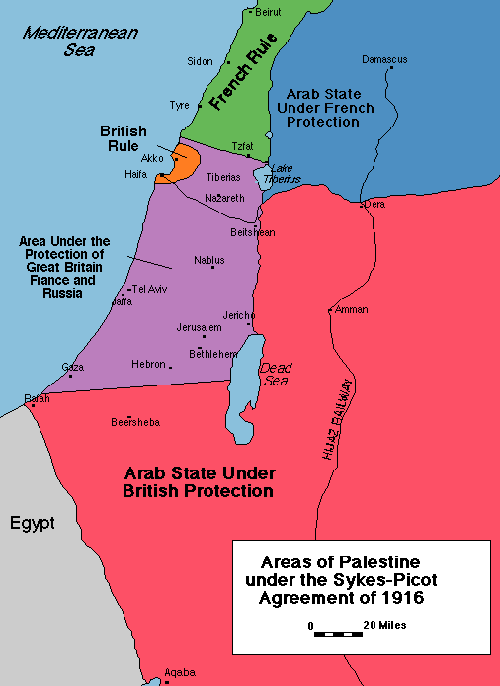


.PNG)

No comments:
Post a Comment